Rethinking Museum Communication in the Digital Age: Open Call for Proposals


OPEN CALL FOR PROPOSALS
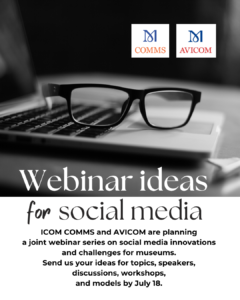


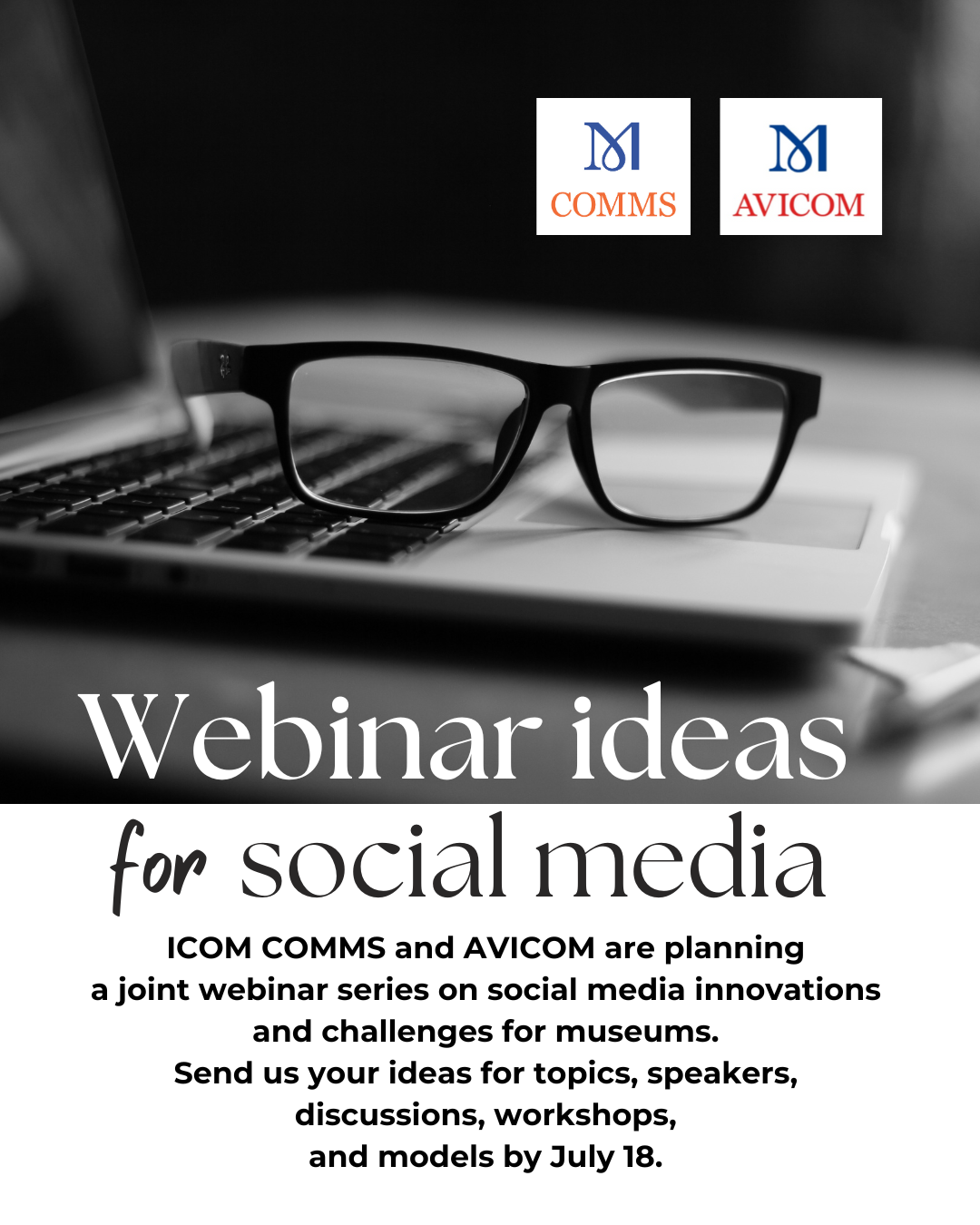
ICOM COMMS and AVICOM are planning a joint webinar series (English) for this fall on social media innovations and challenges for museums. Please send us your ideas for topics, speakers, discussions, workshops, and models.

RETHINKING MUSEUM COMMUNICATION IN THE DIGITAL AGE: POWER, PLATFORMS & POSSIBILITIES ON SOCIAL MEDIA CHANNELS

Organised by: ICOM COMMS, ICOM AVICOM
Location: Online (ZOOM)
Dates: Thursday 11th September, 2nd October, 16th October 2025
Times: to be determined

ABOUT THE WEBINAR SERIES

In an era defined by digital acceleration, political turbulence, and rapidly evolving AI technologies, museums are increasingly challenged to navigate a complex and shifting communications landscape. This webinar series—designed as a three-part online program—invites cultural professionals, researchers, digital creatives, educators, and policymakers to critically examine how museums operate, communicate and engage online, particularly on social media channels.

As digital communication becomes central to cultural participation, museums must adapt to new platforms, diverse audiences, and emerging tools. The series will explore how museums can build authentic digital relationships: from co-creating content with influencers and marginalised communities to negotiating political pressures, and from embracing ethical practices and synthetic media to cultivating inclusive and responsible digital communities.

WEBINAR 1: DIGITAL VOICES IN MUSEUM COMMUNICATION – INFLUENCERS, COMMUNITIES & ENGAGEMENT
Date: Thursday 11th September 2025

Explore strategies to build trust, participation, and cultural branding online. From co-creating content with communities to embracing emerging technologies, these sessions look ahead to responsible digital innovation in museums. Join us for a forward-thinking webinar that explores how museums can develop audiences, foster participation, and stay engaged in the digital age. This session will spotlight innovative engagement strategies, ranging from influencer partnerships to community co-creation. Attendees will gain practical insights into shaping digital identities, curating inclusive narratives, and adopting responsible digital innovation.

We invite contributions on topics such as:

  • 1.1. Influencer partnerships & community co-creation
  • 1.2 AR/VR, synthetic media, and deepfakes
  • 1.3 Digital identities and museum narratives
  • 1.4 Ethical innovation and digital responsibility
  • 1.5 Live demo & content creation workshop

WEBINAR 2: ARTIFICIAL IMAGINATION – USING AI TOOLS TO TELL CULTURAL STORIES

Date: Thursday 2nd October 2025

Social media is transforming how museums communicate, and artificial intelligence is rapidly expanding what’s possible. This hands-on session invites cultural professionals to explore the creative and ethical potential of AI in social media content creation, in particular videos, from scripting and automated voiceovers to animating archival materials and generating subtitles.

Through talks, demonstrations, and real-world case studies, participants will experiment with emerging tools while critically reflecting on issues of copyright, authorship, and algorithmic bias. Whether you’re new to AI or already experimenting with it, this session provides practical insights and ethical frameworks for using AI to craft compelling, responsible cultural content online.

We invite contributions on topics such as:

  • 2.1 Creative uses of AI in producing museum content (video, audio, image)
  • 2.2 Ethical and legal considerations in using AI-generated media
  • 2.3 Copyright implications when using digitised collections with AI platforms
  • 2.4 Case studies of AI-enhanced campaigns (e.g., Instagram reels)
  • 2.5 Tools and workflows for AI-driven content creation
  • 2.6 Live demo & content creation workshop

WEBINAR 3: NAVIGATING POLITICAL INFLUENCE IN MUSEUM SOCIAL MEDIA: POWER, POLITICS AND SOCIAL MEDIA POSTS

Date: Thursday 16th October 2025

Museums are active participants in public discourse, but how independent are they in the digital realm? This webinar examines the political dimensions of museum communication, including funding restrictions, censorship, activist interventions, and crisis management.

Museums today are not only custodians of culture but active agents in shaping public discourse. Social media amplifies this role, but also exposes institutions to direct and indirect political influence—from government funding conditions to censorship, from public backlash to resistance movements.

This webinar invites museum professionals, cultural theorists, digital curators, activists, and policymakers to explore the complex intersection of government, politics, and museum communication in the digital sphere.

We invite contributions on topics such as:

  • 3.1 The role of funding programs in shaping digital museum narratives
  • 3.2 Political agendas (e.g., equality, restitution, sustainability) and their digital footprint
  • 3.3 Social media as resistance: decoloniality, activism, and institutional critique
  • 3.4 Government censorship and media bans
  • 3.5 Institutional responses to online backlash
  • 3.6 The algorithmic power and how to manage algorithmic logics
  • 3.7 The ethics behind the use of social media platforms

WHO SHOULD APPLY

We welcome proposals from:

  • Museum, Gallery & Heritage Professionals
  • Curators, Educators & Cultural Strategists
  • Artists, Creative Technologists & Influencers
  • Researchers in AI, Ethics, Media & Cultural Policy
  • Digital, Media & Content Professionals
  • Students & Early-Career Professionals

SUBMISSION GUIDELINES

Please submit

  • A short abstract (150–250 words) outlining your perspective, project, workshop concept or case study related to the webinar themes.
  • A short bio (max 100 words)
  • Website (if applicable)

Indicate clearly which webinar you are applying to, or note if you wish to be considered for multiple sessions.

Submission form: Submission form COMMS-AVICOM rev

 Email submissions to: avicom@icom.museum
Deadline: Friday 18th July. Successful applicants will be notified by the 30th of July.
Join the AVICOM Board! Candidacies for the 2025–2028 term are now open.

Dear AVICOM members,

This year, new elections for our board are due, which will be confirmed by AVICOM members in November during the ICOM General Conference in Dubai. The candidacy process for these elections is now open.

On this occasion, as the outgoing president, I would like to share my personal thoughts on the composition of the new board: In recent years, AVICOM’s activities have increased enormously, and I look back on a very successful period of our committee’s work, including many joint projects and activities with other ICOM committees. All this has only been possible thanks to the committed and creative collaboration within our board, which also required a great deal of personal time and dedication—for which I am very grateful.

Therefore, anyone who wishes to run for the new board should be aware that board work entails a significant personal commitment. Furthermore, despite increasing online communication and meetings, candidates should be prepared to attend key events in person whenever possible (such as the AVICOM annual conference with the general assembly and board meetings).

Equally important is a spirit of collegial and friendly cooperation within the board, guided by the values set out in our AVICOM Code of Conduct on Sustainability, Climate Protection, and Gender Equality (2024).

In this context, I also believe it is advisable that only AVICOM members from nations with harmonious relations with the international community should apply.

I would also be delighted if all continents were represented on the new board.

I now look forward to many interesting candidacies; young colleagues are just as welcome as senior experts. A wide range of candidates ensures a democratic election in which, hopefully, many AVICOM members will participate.

With warm regards,
Yours,
Michael H. Faber

We will be happy to send you the documents and application form: avicom@icom.museum.

SYMPOSIUM: Museological Framing: An Anthropological And Curatorial Turning Point In Ethnographic And Rural Museums For An Inclusive Future

Symposium 11 of CoCA2026 ‘Museological Framing: An Anthropological And Curatorial Turning Point In Ethnographic And Rural Museums For An Inclusive Future’

Resonating with the values promoted by AVICOM, Symposium 11 of CoCA2026 advocates for ethical museology and explores how digital and audiovisual storytelling, alongside intercultural collaboration, can transform museums into inclusive platforms for shared heritage and cross-cultural dialogue.

At CoCA 2026, Symposium 11 invites museum professionals, anthropologists, and cultural thinkers to rethink ethnographic and rural museums as dynamic, inclusive, and community-powered spaces.

We’re calling for papers that explore:

  • Digital storytelling and shared heritage

  • Decolonisation and restitution

  • Diasporic collaboration and co-curation

Inspired by the same principles upheld by AVICOM, the symposium promotes intercultural dialogue, innovation through digital technologies, and the ethical reinvention of museological practices.

📅 Join us in Barcelona, 28-29-30 January 2026

📝 Submit your abstract in english, spanish, or catalan, by June 30, 2025

🔗 Call for Papers

#CoCA2026 #AVICOM #MuseumsForChange #CulturalJustice #Ethnography #MuseumInnovation

___________________________________________________________________________

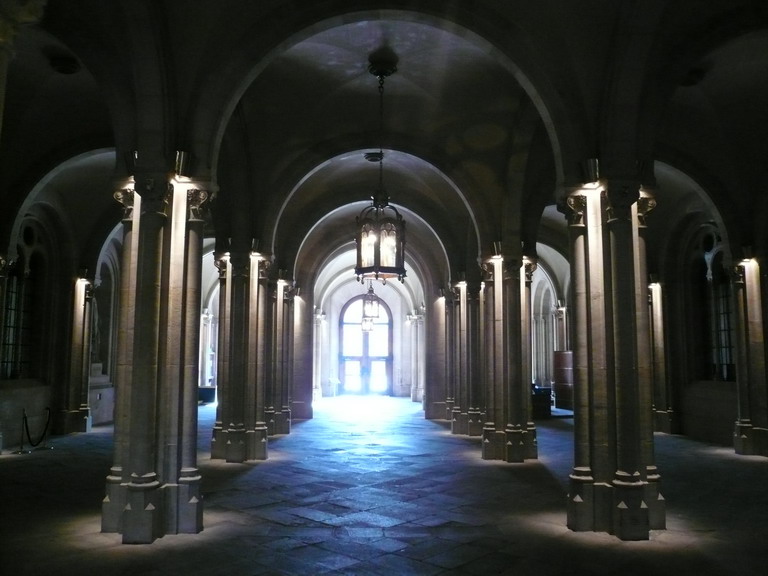
Vestibule of the entrance hall, University of Barcelona

By Pere López – Own work, CC BY-SA 3.0, https://commons.wikimedia.org/w/index.php?curid=3050018

CALL FOR PAPERS

ENGLISH

Call for papers CoCA 2026, International Congress of Anthropology CoCA2026

Symposium 11: Museological framing: an anthropological and curatorial turning point in ethnographic and rural museums for an inclusive future

Currently, the narratives of ethnographic museums are undergoing a major reassessment. Traditionally considered static repositories of tangible culture, these institutions are at the forefront of contemporary discussions on restitution, provenance, and inclusive curation. Current global challenges, colonial legacies, or adapting to constant change, require a transition from rigid interpretations of heritage to dynamic, community-driven frameworks. As hubs of knowledge, these museums can redefine their ethical responsibilities by recognising the hidden histories of collections and promoting multi-vocal representations. This symposium is open to papers that reflect on the evolving responsibilities of ethnographic museums in addressing complexity. It aims to be a space to share alternative approaches that emphasise intellectual collaboration, cultural memory, shared stewardship, and the participation of diasporic communities, and that integrate oral histories, digital technologies, and co-created narratives to evolve as spaces of reconciliation, inclusion, and cultural justice. We seek papers that examine how ethnographic and rural museums address contemporary challenges through innovative practices in the following areas: Decolonisation and cultural restitution; Participatory and collaborative curation; Community narrative and oral history; Use of digital technologies for inclusive interpretation; Shared heritage management; Critical evaluation of collections and exhibition processes. We especially encourage the presentation of case studies, ongoing projects, multidisciplinary research, or collaborative initiatives with local and diaspora groups. Proposals focused on suggestions for museological policies, ethical management practices or frameworks for establishing networks between institutions and social entities are accepted.

https://coca.antropologia.cat/simposi/renquadrament-museologic-un-punt-dinflexio-antropologic-i-curatorial-en-els-museus-etnografics-i-rurals-per-a-un-futur-inclusiu/

Location: Faculty of Geography and History, University of Barcelona

Dates: January 28, 29, and 30, 2026

Submit your abstract in english, spanish, or catalan (300 words) by June 30 2025

https://coca.antropologia.cat/enviament-de-comunicacions-2026/

#Anthropology #Ethnography #CoCABCN2026 #CoCA2026 #ruralmuseums

Español

Convocatoria abierta. CoCA 2026

Simposio 11: Encuadre museológico: un punto de inflexión antropológico y curatorial en los museos etnográficos y rurales para un futuro inclusivo

Actualmente, las narrativas de los museos etnográficos experimentan una importante reevaluación. Tradicionalmente consideradas como repositorios estáticos de cultura tangible, estas instituciones se encuentran en la vanguardia de discusiones contemporáneas sobre restitución, procedencias y curadoría inclusiva. Los desafíos globales actuales, los legados coloniales o la adaptación al cambio constante requieren transitar desde interpretaciones rígidas del patrimonio hacia marcos dinámicos impulsados ​​por la comunidad. Como centros de conocimiento, estos museos pueden redefinir sus responsabilidades éticas reconociendo las historias ocultas de las colecciones y promoviendo representaciones multivocales. Su objetivo es ser un espacio para compartir enfoques alternativos que enfatizen la colaboración intelectual, la memoria cultural, la administración compartida y la participación de las comunidades diaspóricas, y que integren historias orales, tecnologías digitales y narrativas co-creadas para evolucionar como espacios de reconciliación, inclusión y justicia cultural. Buscamos comunicaciones que examinen cómo los museos etnográficos y rurales abordan los desafíos contemporáneos mediante prácticas innovadoras en las siguientes áreas: Descolonización y restitución cultural; Curaduría participativa y colaborativa; Narrativa comunitaria e historia oral; Uso de tecnologías digitales para la interpretación inclusiva; Gestión compartida del patrimonio; Evaluación crítica de colecciones y procesos expositivos. Se recomienda especialmente la presentación de estudios de caso, proyectos en curso, investigaciones multidisciplinares o iniciativas de colaboración con grupos locales y de la diáspora. Se aceptan propuestas centradas en sugerencias de políticas museológicas, prácticas de gestión ética o marcos para el establecimiento de redes entre instituciones y entidades sociales.

https://coca.antropologia.cat/simposi/renquadrament-museologic-un-punt-dinflexio-antropologic-i-curatorial-en-els-museus-etnografics-i-rurals-per-a-un-futur-inclusiu/

Lugar: Facultad de Geografía e Historia, Universidad de Barcelona

Fechas: 28, 29 y30 de enero de 2026

Envía tu resumen en inglés, español o catalán (300 palabras) antes del 30 dejunio

https://coca.antropologia.cat/enviament-de-comunicacions-2026/

#CoCABCN26 #Antropología #Etnografía #museusrurals

CATALÀ

Convocatòria oberta! CoCA 2026 – Congrés Català d’Antropologia CoCA2026

Simposi 11:

Renquadrament museològic: un punt d’inflexio antropologic I curatorial en els museus etnografics i rurals per a un futur inclusiu

Actualment, les narratives dels museus etnogràfics experimenten una important reavaluació. Tradicionalment considerats com repositoris estàtics de cultura tangible, aquestes institucions es troben a l’avantguarda de discussions contemporànies sobre restitució, procedències i curadoria inclusiva. Els desafiaments globals actuals, els llegats colonials o l’adaptació al canvi constant, requereixen transitar des d’interpretacions rígides del patrimoni cap a marcs dinàmics impulsats per la comunitat. Com centres de coneixement, aquests museus poden redefinir les seves responsabilitats ètiques reconeixent les històries ocultes de les col·leccions i promovent representacions multi-vocals. Aquest simposi s’obre a comunicacions que reflexionin sobre l’evolució de les responsabilitats dels museus etnogràfics en abordar la complexitat Vol ser un espai on compartir enfocaments alternatius que emfatitzin la col·laboració intellectual, la memòria cultural, l’administració compartida i la participació de les comunitats diaspòriques i que integrin històries orals, tecnologies digitals i narracions co-creades per evolucionar com a espais de reconciliació, inclusió i justícia cultural. Busquem comunicacions que examinin com els museus etnogràfics i rurals aborden els desafiaments contemporanis mitjançant pràctiques innovadores en les següents àrees: Descolonització i restitució cultural; Curaduría participativa i col·laborativa; Narrativa comunitària i història oral; Ús de tecnologies digitals per a la interpretació inclusiva; Gestió compartida del patrimoni; Avaluació crítica de col·leccions i processos expositius. Recomanem especialment la presentació d’estudis de cas, projectes en curs, recerques multidisciplinars o iniciatives de col·laboració amb grups locals i de la diàspora. S’accepten propostes centrades en suggeriments de polítiques museològiques, pràctiques de gestió ètica o marcs per a l’establiment de xarxes entre institucions i entitats socials.

https://coca.antropologia.cat/simposi/renquadrament-museologic-un-punt-dinflexio-antropologic-i-curatorial-en-els-museus-etnografics-i-rurals-per-a-un-futur-inclusiu/

Lloc del congrés: Facultat de Geografia i Història, Universitat de Barcelona

Dates: 28, 29 i 30 de gener 2026

Envia el teu resum en anglès, castellà o català (300 paraules) abans del 30 de juny 2025:

https://coca.antropologia.cat/enviament-de-comunicacions-2026/

#CoCABCN26 #Antropologia #Etnografia #CoCA2026 #museusrurals

Submit your contributions now! AVICOM F@IMP Media Festival in Dubai

The AVICOM’s nearly 30-year-old audio-visual and multimedia F@imp Festival has successfully renewed itself over the decades while preserving its traditions.
In 2023, AVICOM updated the submission categories and awards to reflect the new museum definition’ key concepts.

The new award categories are:
Museum film, animation
Media
Web
Exhibition installation
Mobile application.
The new awards are (instead of gold, silver and bronze awards):
Research, documentary
Education and mediation
Interpretation
Inclusivity and sustainability.

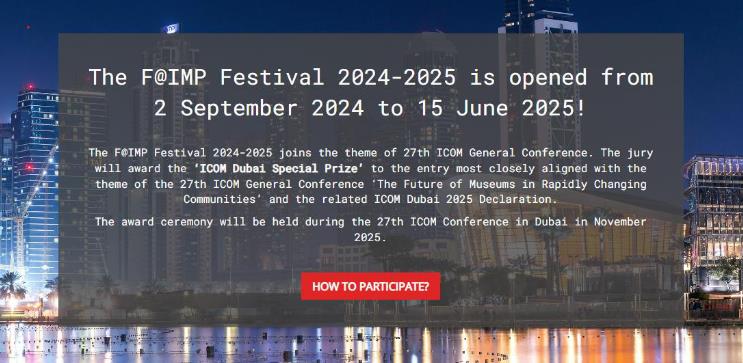
The F@imp Festival 2024-2025 is already open, accepting the entries through 7 September 2025 at faimpavicom.org site. We are waiting for the great applications!

This year the jury will award the ‘ICOM Dubai Special Prize’ to the entry most closely aligned with the
theme of the 27th ICOM General Conference ‘The Future of Museums in Rapidly Changing
Communities’ and the related ICOM Dubai 2025 Declaration.
The award ceremony for the 2024-2025 FAIMP Festival will be held during the 27th ICOM Conference in Dubai in November 2025.

All applications and winners of the Festival from 2016 to 2023 can be found here: https://faimpavicom.org/#/faimp/work
All information about the Festival is available on faimpavicom.org site.
Email address: faimp.avicom@gmail.com


Call for papers: Heritage, museums, collections. Professionals’ sharing of skills between Africa and Europe

Heritage, museums, collections. Professionals’ sharing of skills between
Africa and Europe.

Conference, Rome, 24-25 September 2025. Call for papers.
(ICOM Europe-ICOM Africa, ICOM Arab, Italian Ministry of Culture DIVA, ICOM Italy, ICOFOM, SUSTAIN, MPR, AVICOM, INTERCOM, ICOM WGD)

Debates involving museums and decolonization practices are ongoing and evolving, taking
into account the global consequences of colonialism in contemporary societies, including
social and economic inequalities, the marginalization of certain populations, ongoing
threats to indigenous peoples and their traditional lands, institutional racism, and sexism
in all their forms.

Decolonization, in its many uses by museums and curators, is a practice and an effort that
sits within a continuum – which in turn looks different in different parts of the world –
addressing various difficult histories related to political relations and processes of the
Empire formation, and resulting in various experimental solutions. But one general thing
we must recognize from the current debate is the fact that “decolonization” is about
probing into the systems used, the destruction wrought and remedying, by telling the
difficult truth of its ruthlessness. Restitution involves not only a material (and legal)
transfer of colonial objects, but also a spiritual return of identity knowledge that had been
taken off. More significantly, for people claiming their right to memory, restitution means
a reconnection with history: a reconnection that requires their collaboration with the
institutions that narrate the colonial past, by engaging in collaborative practices to
reconnect with the material traces of their past that are currently held by European
museums in order to use and/or rediscover traditional knowledge, and engaging in
collaborative practices, African and Afro-descendant curators, artists, activists, and
scholars. European museums are rewriting narratives, changing practices, and sharing
their imagery and knowledge as a mean to ‘decolonize’.

Sharing must lead to the recognition of cultural diversity and consequently to thinking of
the museum not as an absolute entity with similar characteristics – which are also ‘colonial’
in the exportation of the Western historical model -, but as realities linked to processes of
memory formation, processes which, for historical, anthropological and sociological
reasons, cannot respond to absolute models but respond to territorial realities that develop
their own models. The presence, in terms of quality and quantity, of tangible and intangible works of African
provenance in European museums, dedicated institutions, religious, missionary,
ethnological and scientific institutions, mainly universities, is enormous and partially
unknown.

For all collections not subject to restitution, a long task awaits the depository museums,
their reconnaissance and cataloguing with the verification of provenance and the definition
of the exhibition criteria and the museological projects for their enhancement (mediation
apparatus, conservation, restauration and educational projects).

The difficulties of interpretation, more generally, concern all art that does not belong to
long-standing cultural systems. By referring to studies focused on cultures other than our
own, we are able to recover visions and attitudes that allow us to understand our own
heritage much better and recover the intelligence of our past.

It is precisely for this reason that the European musealization of objects from outside
Europe cannot take place without dialogue on the pivotal concepts for such collections, the
concept of heritage and museum.

The conference in the present document wants to exchange views about new ways of
considering African museum heritage in European museums by comparing concepts of
museum and heritage in European and African thought and practice.

It will include two in-depth conceptual sessions with four keynote speakers, two from
Europe and two from Africa, followed by two panel discussions. This session will be
followed by three panels of comparative experiences between European and African
museologists and museum professionals, summarised in a final discussion of reports and
posters.

Papers and posters should refer to the conceptual choice of the conference and, in
particular, to three areas (panels):

– Heritage and museum. Musealisation, conservation, digital, restoration, research, study
and cataloguing.

– Museum displays. New readings and new interpretations.

– Heritage. Museums. Collections. The communities’ role.

The scientific committee will particularly appreciate the account and highlighting of
challenges (political, social, technological, managerial, organisational, personnel and
personnel training) faced by African and European museum professionals as they work
toward a more anticolonial relationship.

Speakers are invited to submit their proposals in English or French with a short
explanatory text (max. 300 words), the title and the chosen area (panel), indicating
whether the presentation is to be a lecture or a poster.
Speakers chosen by the scientific committee will have to present their paper in person; online papers are not foreseen. The invitation includes the coverage of the expenses for travels and accommodations at the conference venue.

Posters may be sent, also by e-mail, to the conference organisation, printed and displayed
at the expense of the conference. No reimbursements for travels and accommodations
expenses are provided for the writers of the posters.

All proposals must be received by 25 May 2025 by the writer (chair.icomeurope@gmail.com). Proposals received after this date cannot be evaluated and considered. Admissions will be notified by June 10, 2025.

Joint webinar “Social Media” by MPR and AVICOM: Experts wanted.

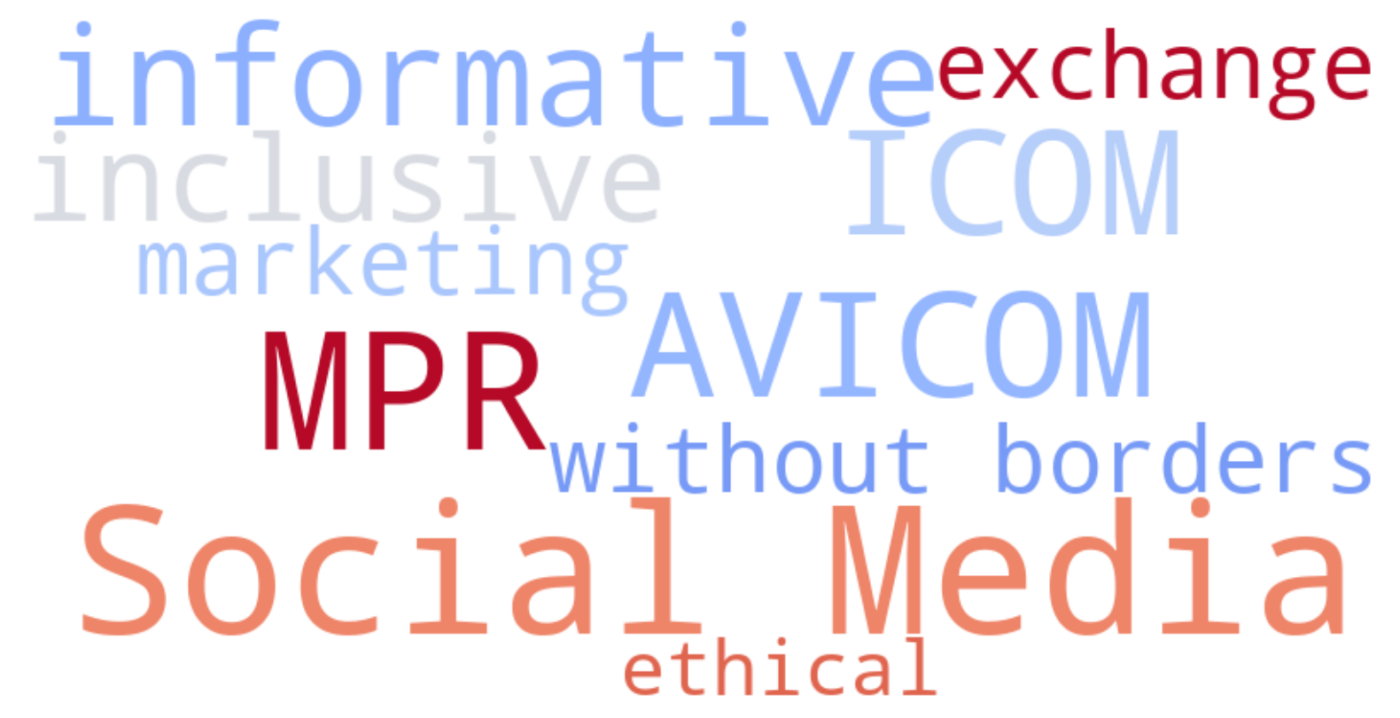
The International Committees MPR and AVICOM are planning a webinar on the topic of “Social Media” in preparation for their joint session at the ICOM General Conference in Dubai. This webinar is scheduled to take place in the summer. It will address questions regarding the efficient, sustainable, and inclusive use of social media by museums, as well as legal and ethical aspects. A small working group is now being formed to prepare and conduct this webinar. If you have an academic background in social media usage or consider yourself an expert in this field and are interested in volunteering for this working group, please contact avicom@icom.museum. Thank you!

“The Table is set”: The new online exhibition in cooperation with AVICOM goes live 14 March

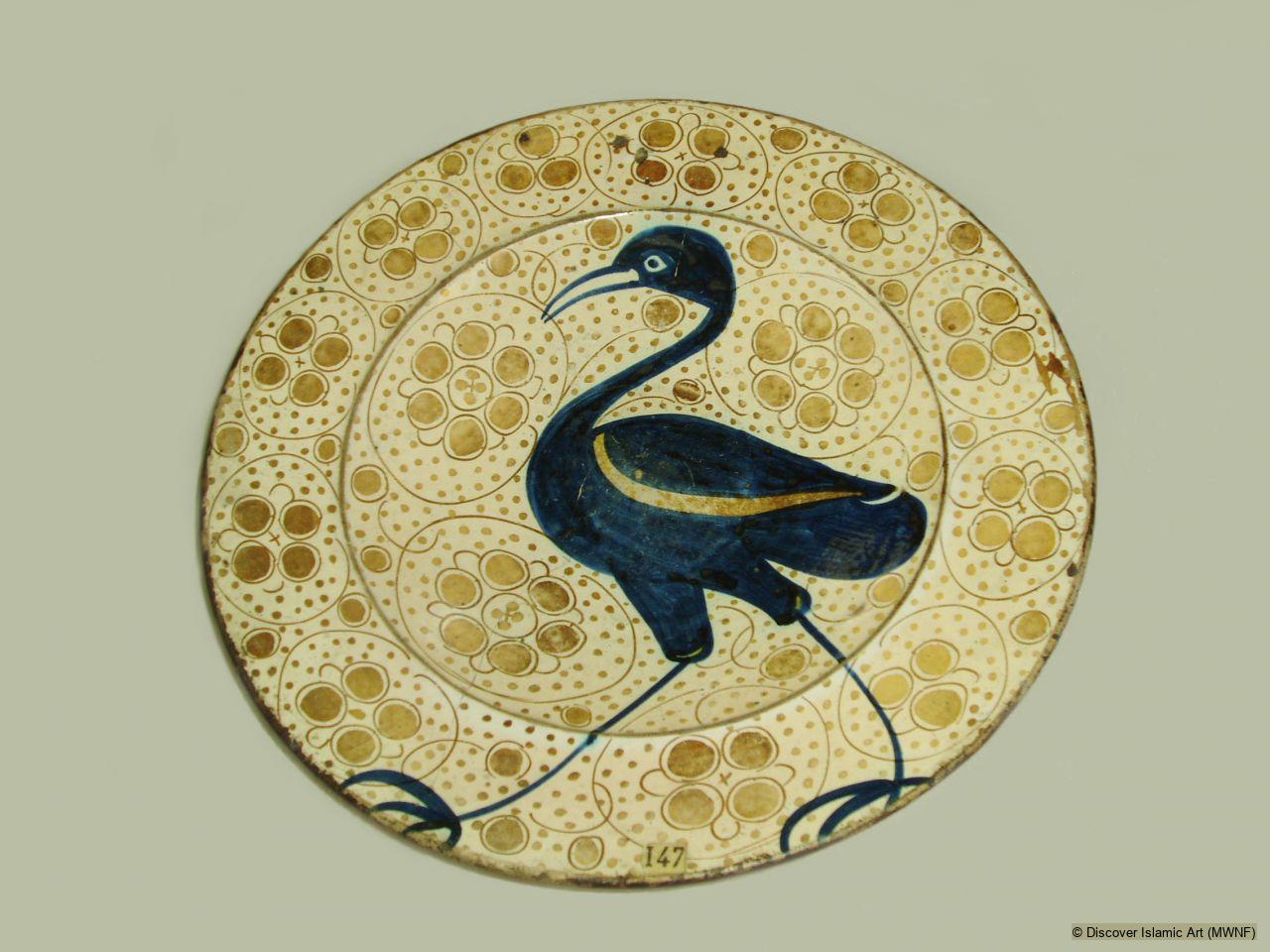
National Archaeological Museum Madrid: Dish

Within the MWNF programme on the occasion of Ramadan 2025
In cooperation with AVICOM
Under the patronage of UNAOC:

The new Museum With No Frontiers online exhibition The Table is set. Food Traditions and Legacies in the Islamic World will go live on Friday 14 March 2025 at 00:00 CET:

https://exhibitions.museumwnf.org/the_table_is_set/en/

MWNF_TableIsSet_Announcement_010325

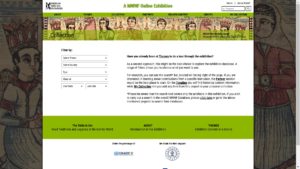
Collection Start Page

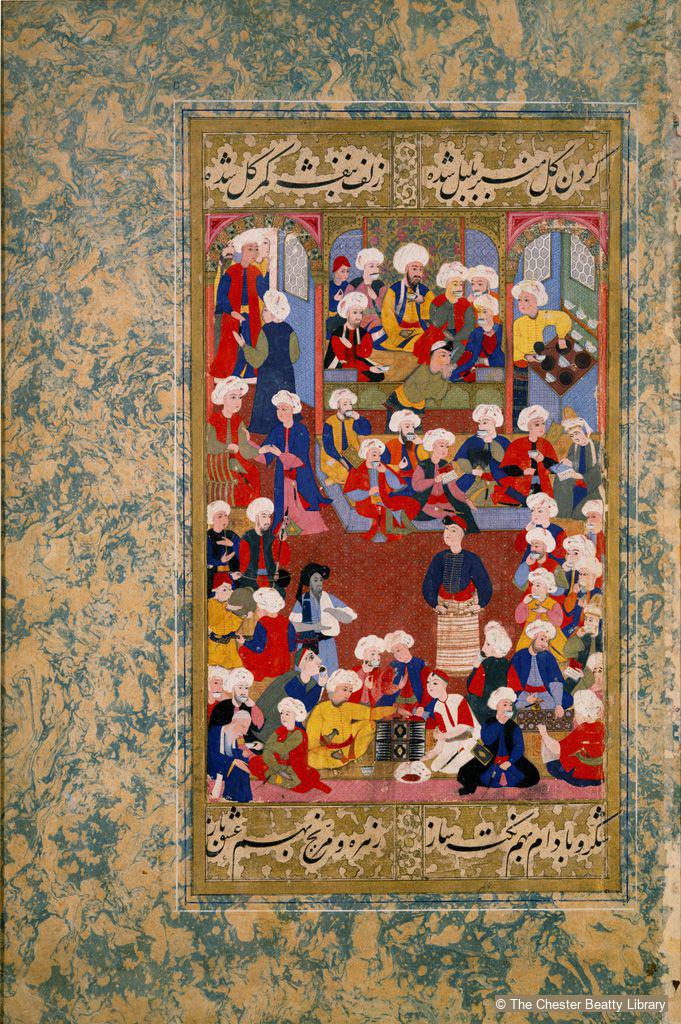
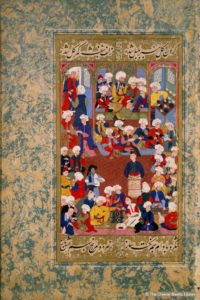
Chester Beatty Library Dublin: Coffie House

Press Text:
This exhibition by Museum With No Frontiers explores the rich food and culinary traditions of the Islamic world, offering a deeper understanding of Islamic culture and fostering cross-cultural dialogue. What sets this exhibition apart is its uniquely international approach, with a curatorial team drawn from diverse cultural, professional, and academic backgrounds. Combined with remarkable collections from various museum partners, it embodies MWNF’s commitment to cultural diversity.
The key advantage of a digital online exhibition is its unparalleled accessibility, allowing people to engage with it regardless of location or financial means. This global reach democratises knowledge and encourages inclusivity, overcoming the geographic and financial limitations of physical exhibitions. Digital exhibitions avoid the expenses of transporting, insuring, and conserving fragile artefacts like manuscripts and photographs, which can remain accessible indefinitely in digital form. Viewers can enlarge images to explore details, enhancing the educational experience. The involvement of an international team fosters a diverse and inclusive narrative, moving beyond narrow perspectives, and the digital format can include objects from multiple institutions, offering depth that physical exhibitions often struggle to achieve.
The virtual exhibition also makes possible the inclusion of monuments, offering an immersive exploration of architectural and cultural landmarks that cannot be physically transported. MWNF maintains an extensive database of cultural heritage objects, sites, and monuments, providing exhibition visitors with comprehensive and engaging experiences that enhance their understanding of historical and artistic contexts.
Food, a basic human necessity, is a force that can unite or divide, foster peace, or spark conflict. It is not merely a means of survival, but a reflection of cultural identity, personal preferences, and the dynamics of social, political, and economic power. The exhibition’s curatorial perspective is structured around six main themes, each shedding light on the pivotal roles food has played in shaping the Islamic world.
Theme I, Life at the Court, focuses on ways in which food was central to Islamic courts, which served as more than just physical spaces. They were hubs of power, social life, and cultural development. Elaborate meals, refined table etiquette, and newly-created recipes symbolised status and prestige, contributing to the development of culinary arts and cultural identity.
Theme II, Social Life, examines food as a universal medium for connection, and for sharing beliefs, values, and social hierarchies. Across the Islamic world, communal meals fostered intimacy, belonging, and unity.
Theme III, Religion, explores the intricate relationship between food and faith in Islamic culture. Religious beliefs shaped and are still shaping food practices, from dietary laws to traditions observed during festivals such as Ramadan and the Eids. More than just nourishment, food in Islamic culture represents humility, hospitality, and discipline, creating a profound connection between the individual and the divine.
Theme IV, Environment, highlights how Islamic civilisation developed sustainable agricultural practices that balanced environmental stewardship with human needs. From innovative farming techniques and water management to soil care, these practices ensured resource sustainability while shaping culinary traditions. This theme also explores the ways in which cultural exchanges influenced ingredients, cooking techniques, and serving practices.
Theme V, Gender Roles, focuses on the collaborative contributions of men and women in food production, preparation, and presentation. Together, their efforts shaped the culinary and social legacy of the Islamic world, evidence of the dynamic balance of responsibilities in sustaining food traditions and cultural values.
Theme VI, Coexistence, explores how food acted as a unifying force in the multicultural Islamic world. Despite communities’ religious and social differences, shared meals fostered connections and enriched food traditions. Culinary interactions led to vibrant food-related industries and a rich material culture, with fusion cuisines reflecting both unity and diversity. Food became a powerful symbol of coexistence, transcending boundaries and facilitating cultural exchange.
This exhibition is more than a showcase of culinary traditions; it is an exploration of how food shapes identity, fosters resilience, and transcends time and geography. By connecting the diverse legacy of the Islamic world to contemporary practices, it reveals food as a bridge between past and present, tradition and innovation. Through its themes, the exhibition invites visitors to reflect on food’s profound ability to nurture not just the body, but also the bonds that unite communities and cultures. It shows that the simple act of sharing a meal carries universal meaning—offering hope, understanding, and the potential for greater harmony in a complex, interconnected world.


Virtual Museums – A Plea: New Publication supported by AVICOM – Free Download!

Around the clock. Around the world” – a plea for virtual museums”

Establish virtual museums!” is the plea of the ‘Virtual Museums Forum’ group. In their just published book “Virtual Museums – A Plea”, 11 authors from the fields of culture, science, business and law discuss the opportunities that digital technologies open up for the cultural sector when virtual museums are created. In their book, which is printed but also available for download in open access mode, the group of authors, whose core is at Heinrich Heine University Düsseldorf/Germany, provides an overview of the characteristics and especially the possible fields of application of virtual museums. These are created exclusively on the Internet and may complement analogue museums without replacing them. The group of authors points out the advantages and disadvantages of virtual museums and discusses their structure and organization, legal and technological aspects as well as the question of sustainability.

This contribution to the discussion on specific digitization in the museum sector was elaborated and published with strong support by AVICOM. It is published in October 2024 by de Gruyter Publisher / Deutscher Kunstverlag / düsseldorf university press (parallel in German and English language). It was presented by Prof. Dr. Bernd Günter (HHU Düsseldorf) on October 18 at the AVICOM conference in Turin/Italy.

On behalf of the group of authors, Dr. Julia Römhild and Professor Dr. Bernd Günter (both HHU Düsseldorf) are grateful for any feedback and discussion. They provide insights into the characteristics, requirements and opportunities of virtual museums.

Download of the book at: www.deGruyter.com

https://www.degruyter.com/document/doi/10.1515/9783422802339/html

https://www.degruyter.com/document/doi/10.1515/9783422802377/html

Licence: https://creativecommons.org/licenses/by/4.0/


Contact:

Dr. Julia Römhild, Academic Lecturer and Researcher for Cultural Management,
Heinrich-Heine-Universität Düsseldorf / Germany
e-mail:
julia.roemhild@hhu.de

Prof. Dr. Bernd Günter, Professor (em.) for Business Administration/Marketing, Heinrich-Heine-Universität Düsseldorf / Germany
e-mail:
guenter@uni-duesseldorf.de

Info-PDF_Virtual Museums